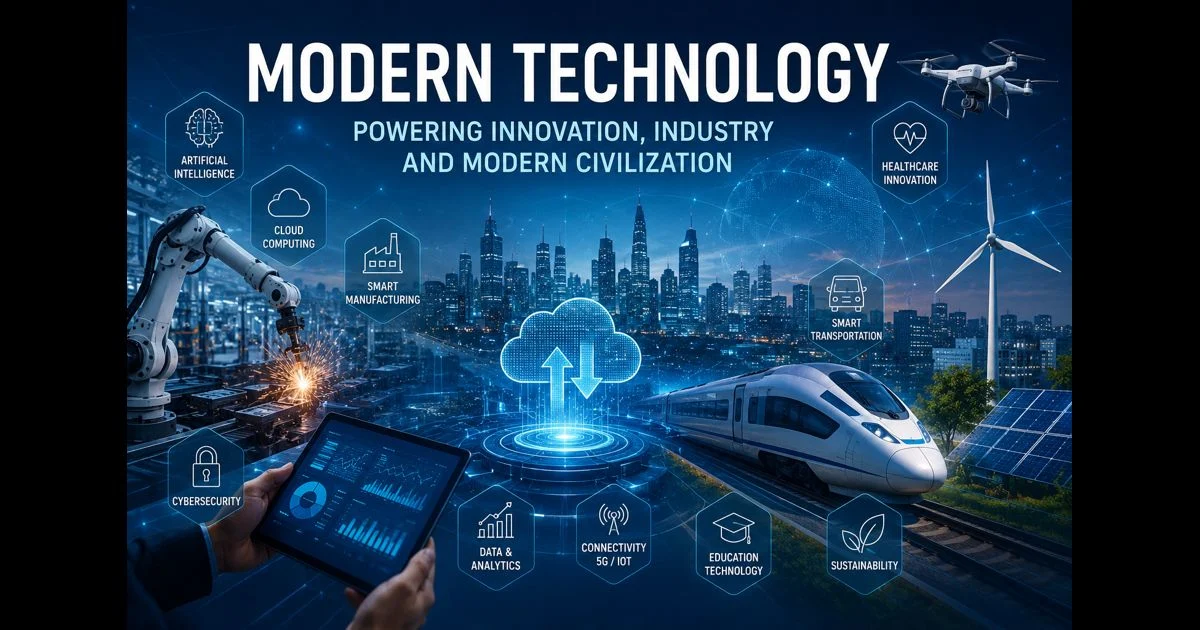
Technology is often described through visible products: smartphones, robots, electric vehicles, medical scanners, and artificial intelligence tools. Yet its deeper influence comes from the systems behind those products. Energy networks, communication standards, semiconductor supply chains, software platforms, skilled workers, research institutions, and public policy all determine whether an invention becomes dependable enough to improve everyday life.
In practical terms, technology is the application of knowledge to solve problems, perform work, and extend human capability. It may take the form of a simple tool, an industrial process, a digital service, or an infrastructure network used by millions of people. Its value does not come from novelty alone. A technology matters when it is useful, reliable, accessible, maintainable, and safe in the environment where it operates.
Modern civilization depends on this combination of tools and systems. Hospitals use it to coordinate care, manufacturers use it to control quality, farms use it to manage limited resources, and governments use it to deliver essential services. The same dependence also creates new responsibilities. When technology becomes part of critical infrastructure, failures can affect far more than a single user or organization.
Technology Turns Knowledge Into Working Systems
Scientific discovery and technological innovation are closely related, but they are not the same. Science develops knowledge about the natural and social world. Engineering applies that knowledge to design solutions. Technology brings those solutions into practical use through equipment, software, processes, standards, and trained people.
An invention may prove that something is possible. Innovation begins when that possibility is refined into something people can use at a realistic cost and scale. This journey usually includes research, prototyping, testing, manufacturing, deployment, maintenance, and continuous improvement. Each stage can determine whether a promising idea succeeds or disappears.
Consider a sensor designed to detect abnormal vibration in industrial machinery. The sensor alone does not create much value. It must produce accurate readings, connect securely to a network, work in harsh conditions, integrate with maintenance systems, and present information that technicians can act on. The complete system—not the component in isolation—allows a factory to detect wear before equipment fails.
This is why meaningful technological progress is usually cumulative. New capabilities build on decades of work in materials, computing, communications, manufacturing, and design. Even a breakthrough depends on an existing foundation that allows it to leave the laboratory.
The Hidden Infrastructure Behind Everyday Life
A routine digital action can depend on a surprisingly large physical and technical chain. Sending a payment, joining a video call, or opening a medical record may involve a personal device, local network equipment, fiber-optic cables, data centers, software services, identity checks, encryption, and electricity systems—all operating within seconds.
Modern digital infrastructure includes:
- Fixed and mobile communication networks
- Satellites, undersea cables, and internet exchange points
- Semiconductors, servers, and data centers
- Operating systems, databases, and software platforms
- Digital identity and payment systems
- Technical standards that allow different systems to communicate
Many organizations use cloud computing to access storage, processing power, and software without operating every part of the underlying hardware themselves. That flexibility can support rapid growth, remote collaboration, data analysis, and service recovery. It does not remove the need for physical infrastructure; it changes how that infrastructure is accessed and managed.
The reliability of this hidden stack is central to economic and social stability. A service may have excellent software but still fail because of a damaged cable, unavailable power, incorrect configuration, or incompatible database. Resilient systems therefore need redundancy, tested recovery plans, clear ownership, and the ability to continue essential operations when one component fails.
Industry Has Moved From Machines to Connected Production
Industrial technology once focused mainly on making individual machines faster or more powerful. Modern production increasingly connects equipment, workers, suppliers, software, and operational data. Information can move from a sensor on a production line to a maintenance team, inventory system, or quality-control process in real time.
This connected model supports several practical improvements:
- Sensors can reveal temperature, pressure, vibration, or energy changes before they cause defects.
- Computer vision can help identify inconsistencies that require human inspection.
- Robotics can handle repetitive, hazardous, or precision-intensive work.
- Simulation can test designs and production changes before physical resources are committed.
- Supply-chain systems can help teams respond to shortages or delays earlier.
The purpose is not simply to automate every task. Some processes are too variable, sensitive, or dependent on judgment for full automation to be useful. Effective industrial systems assign repetitive monitoring and calculation to machines while keeping people responsible for exceptions, safety, maintenance, and final decisions.
Connected production also creates dependencies. Older equipment may not communicate with modern software. Inaccurate sensor data can lead to poor decisions. A network problem can interrupt operations that once functioned independently. Successful modernization therefore combines new technology with equipment knowledge, worker training, secure integration, and realistic plans for legacy systems.
Artificial Intelligence Changes How Information Is Used
Artificial intelligence extends the ability of computers to classify information, recognize patterns, generate content, and support decisions. Its most useful applications are usually tied to a defined problem: identifying unusual financial activity, forecasting demand, assisting with medical-image review, translating text, inspecting manufactured components, or helping employees search large collections of organizational knowledge.
AI is powerful because it can process more information than a person could review manually. It is limited because its output depends on training data, system design, operating conditions, and the way a task is framed. A model can produce a confident answer that is incomplete or wrong. It can also reproduce bias, expose sensitive data, or lose accuracy as real-world conditions change.
Responsible use requires more than selecting a capable model. Organizations need to decide which decisions may be automated, when a person must review an output, how performance will be monitored, and who remains accountable when the system fails. High-impact uses demand stronger validation and oversight than low-risk tasks such as organizing routine documents.
The best results often come from combining machine speed with human context. AI can narrow a large field of possibilities, but people must judge whether the result is appropriate, lawful, safe, and relevant to the situation.
Technology Reshapes Organizations Before It Reshapes Markets
Buying software does not automatically improve a business or public institution. Technology creates value only when it fits the work around it. That may require redesigning a process, clarifying who owns a decision, improving data quality, training employees, or removing duplicate systems.
A retailer may connect inventory data with sales forecasts to reduce stock shortages. A logistics company may combine vehicle location, traffic conditions, and delivery priorities to improve routing. A public agency may replace repeated paper submissions with a secure digital record that citizens can reuse. In each case, the benefit comes from a better operating model rather than the presence of new software alone.
Useful measures focus on outcomes such as shorter waiting times, fewer errors, safer operations, lower waste, improved accessibility, or faster recovery from disruption. Counting installed applications or automated tasks can create an impression of progress without showing whether the organization actually works better.
Technology strategy must therefore begin with a clear problem. Teams need to understand the current workflow, the people affected, the cost of change, the risks introduced, and the evidence that will show whether the investment succeeded.
Healthcare Depends on Connection, Evidence, and Oversight
Healthcare technology includes far more than advanced equipment. Digital records, laboratory systems, imaging tools, remote consultations, wearable devices, scheduling platforms, and clinical decision support all influence how information moves through a care system.
When these tools work together, clinicians can access relevant history more quickly, patients can receive follow-up without unnecessary travel, and researchers can analyze complex biological data. Remote monitoring may also help care teams notice changes between appointments, particularly for patients managing long-term conditions.
However, more data does not automatically produce better care. Records must be accurate, systems must exchange information reliably, and alerts must be designed carefully enough to avoid overwhelming clinical staff. Privacy, informed consent, usability, and unequal access also affect whether a tool benefits patients in practice.
Medical technology should support clinical expertise rather than obscure responsibility. Evidence, validation, professional judgment, and patient safety remain essential even when a system is highly automated.
Energy, Transport, Agriculture, and Cities Are Becoming Coordinated Systems
Physical infrastructure is increasingly managed with digital information. Electricity networks use monitoring and forecasting to balance supply with changing demand. Transport operators use live conditions to coordinate routes and maintenance. Farmers use soil, weather, and crop data to guide irrigation and other inputs. Cities use sensors and control systems to manage water, traffic, lighting, and public facilities.
These applications share a common pattern: they make conditions more visible so that limited resources can be used more precisely. Better visibility can reduce waste, anticipate faults, and improve planning. It can also help essential services recover more quickly after disruption.
The benefits depend on local conditions. A precision-agriculture platform has limited value where connectivity is unreliable or equipment cannot be repaired locally. A smart traffic system may shift congestion rather than reduce it if planners focus on one junction instead of the wider network. Technology must be matched to infrastructure, maintenance capacity, community needs, and long-term operating costs.
Education Is About Capability, Not Screen Time
Digital platforms have expanded access to lectures, libraries, simulations, and collaboration across distance. They can support learners who need flexible schedules, accessible formats, or resources unavailable in their immediate location. Educators can also use digital tools to provide feedback, demonstrate complex ideas, and connect students with wider research communities.
Access to a device, however, is not the same as access to meaningful education. Learning still depends on sound teaching, relevant material, motivation, feedback, and the ability to judge information critically. Poorly designed tools can distract from learning or create extra work for teachers without improving outcomes.
Digital literacy has therefore become a core civic and professional skill. People need to understand how to verify sources, protect personal information, recognize manipulation, and use automated tools without surrendering judgment. As synthetic media and AI-generated content become more common, these abilities are as important as knowing how to operate a device.
Work Changes at the Level of Tasks
Technology rarely transforms every part of an occupation at once. It usually changes particular tasks. Software may prepare a first draft, schedule routine work, analyze a dataset, or monitor equipment, while people continue to handle negotiation, accountability, care, strategy, and unusual situations.
This task-level view gives organizations a more realistic way to plan. They can identify work that is repetitive, hazardous, or slowed by poor information and then decide whether automation, better tools, or process redesign would help. They can also identify skills that become more important when routine activity is reduced.
Workforce preparation should not begin after a system is deployed. Employees often know where a process fails and which exceptions matter. Involving them during design can improve usability, reveal hidden risks, and reduce resistance. Training must cover not only how to operate a tool but also when not to trust it and how to escalate a problem.
The long-term question is not whether people or machines will perform all work. It is how responsibility, skills, and opportunity will be distributed as the tools change.
Security and Privacy Are Part of the Design
Every connected system creates a pathway through which information or control can move. That pathway can support useful services, but it can also be misused. As hospitals, factories, vehicles, financial platforms, and public services become more connected, a security incident can interrupt physical operations as well as expose data.
Effective cybersecurity is not a product added at the end of a project. It begins with decisions about what information is collected, who can access it, how systems are updated, and what happens if a supplier or component is compromised.
A strong approach commonly includes secure configuration, identity and access controls, encryption, backups, monitoring, software updates, employee awareness, vendor assessment, and a rehearsed incident-response plan. Privacy requires equal attention. Collecting information simply because it is technically possible can create risk without delivering corresponding value.
Trust grows when organizations minimize unnecessary data, explain important uses clearly, and remain accountable for the systems they operate. Without that trust, even a technically impressive service may struggle to gain lasting adoption.
Digital Technology Still Has a Physical Footprint
Digital services can appear weightless, but they depend on electricity, water, buildings, network equipment, batteries, and mined materials. Devices must be manufactured and transported. Data centers must be powered and cooled. Hardware eventually reaches the end of its useful life.
Technology can help improve environmental performance through efficient logistics, energy monitoring, renewable-power integration, precision agriculture, and better material tracking. At the same time, rapidly replacing devices, running inefficient software, or collecting unnecessary data can increase energy use and electronic waste.
A responsible approach considers the full life cycle of a system:
- How materials are sourced
- How efficiently the product operates
- Whether it can be repaired or upgraded
- How long software and security support will continue
- Whether equipment can be reused or recycled
- What happens to data and hardware when the service ends
Efficiency gains also need to be measured against total use. A device may consume less energy per task while overall consumption rises because it is used at a much larger scale. Sustainability claims are stronger when they account for the complete system rather than a single feature.
Unequal Access Limits the Benefits of Innovation
Technology can expand opportunity, but it does not distribute that opportunity automatically. Connectivity, device cost, language, disability access, digital skills, and trust all influence who can use a service. A platform may be available worldwide yet remain effectively inaccessible to people with slow connections, limited literacy, or unsupported languages.
This gap matters when digital channels become the main route to employment, education, banking, healthcare, or government support. If an essential service assumes that every user has a modern device and reliable broadband, technological progress can deepen an existing disadvantage.
Inclusive design considers different abilities, devices, connection speeds, and levels of experience from the beginning. Essential services may also need assisted or offline alternatives. The most successful systems are not merely advanced; they work for the people expected to depend on them.
Why Promising Technology Projects Fail
Many projects fail for organizational reasons rather than technical ones. A system may work exactly as designed and still solve the wrong problem. Common causes include unclear goals, poor-quality data, incompatible legacy systems, weak ownership, inadequate training, unrealistic budgets, and no plan for maintenance after launch.
Projects are also vulnerable when teams treat adoption as an announcement instead of a process. People need time to learn new workflows, understand how their roles change, and report problems safely. Leaders need evidence that the system is improving outcomes rather than moving work from one department to another.
Several questions can expose weaknesses early:
- What specific problem should this system solve?
- Who benefits, and who carries the new burden or risk?
- Which existing systems and processes must it connect with?
- What happens when the system is unavailable or wrong?
- Who is responsible for updates, security, and long-term maintenance?
- Which measurable outcome will justify continued investment?
Clear answers do not guarantee success, but they separate purposeful adoption from technology purchased mainly because it is fashionable.
The Next Era Will Be Shaped by Convergence
Future progress is likely to come from technologies working together. Artificial intelligence may improve the control of robots, while advanced sensors provide the data both require. Biotechnology increasingly relies on computing, and new materials can improve batteries, medical devices, construction, and manufacturing. Quantum technologies may eventually support specialized scientific and industrial problems, but practical value will depend on reliability, cost, and integration with existing systems.
Convergence increases capability and complexity at the same time. A connected vehicle, for example, combines mechanical engineering, batteries, sensors, navigation, communications, software, and security. Improving one component is useful only if the entire system remains safe and dependable.
This makes interoperability, standards, testing, and governance central to the next stage of innovation. The most influential advances may not always be the most dramatic. Better batteries, cheaper sensors, more efficient chips, accessible interfaces, or stronger technical standards can unlock progress across many industries at once.
Responsible Progress Is a Continuing Choice
Technology is neither automatically beneficial nor inherently harmful. Its effects are shaped by design choices, incentives, access, regulation, maintenance, and the way people use it. A system optimized only for speed or profit may create costs elsewhere, while one designed around safety, accessibility, and long-term value can strengthen both institutions and daily life.
Modern civilization will continue to rely on technological progress, but progress should be judged by more than capability. The better test is whether technology solves a real problem, improves human well-being, earns public trust, uses resources responsibly, and remains dependable when people need it most.
Innovation begins with possibility. Lasting value comes from turning that possibility into a system society can understand, maintain, and use with confidence.
Frequently Asked Questions
What is the difference between technology and innovation?
Technology is the practical application of knowledge through tools, systems, and processes. Innovation is the successful introduction or improvement of an idea in a way that creates useful value. A new technology can enable innovation, but it becomes meaningful only when it solves a real problem effectively.
How does technology improve industrial productivity?
Technology can improve productivity by making operating conditions more visible, automating repetitive work, reducing errors, supporting preventive maintenance, and coordinating production with inventory and supply chains. Results depend on good data, trained workers, reliable integration, and appropriate process design.
What are the main risks of modern technology?
Major risks include security breaches, privacy loss, unreliable automated decisions, unequal access, worker disruption, system dependence, environmental costs, and failures in critical infrastructure. These risks can be reduced through careful design, oversight, testing, maintenance, and clear accountability.
Can technology support sustainability?
Yes. Technology can improve energy efficiency, resource monitoring, transport planning, renewable-energy integration, precision agriculture, and material recovery. Its own use of electricity, water, equipment, and raw materials must also be considered across the full life cycle.
Will artificial intelligence replace human workers?
AI is more likely to change particular tasks than replace every part of most occupations. It can automate routine analysis or content processing, while people remain essential for judgment, accountability, empathy, strategy, and handling unfamiliar situations. The outcome will depend heavily on job design, education, and how organizations share the benefits of productivity.