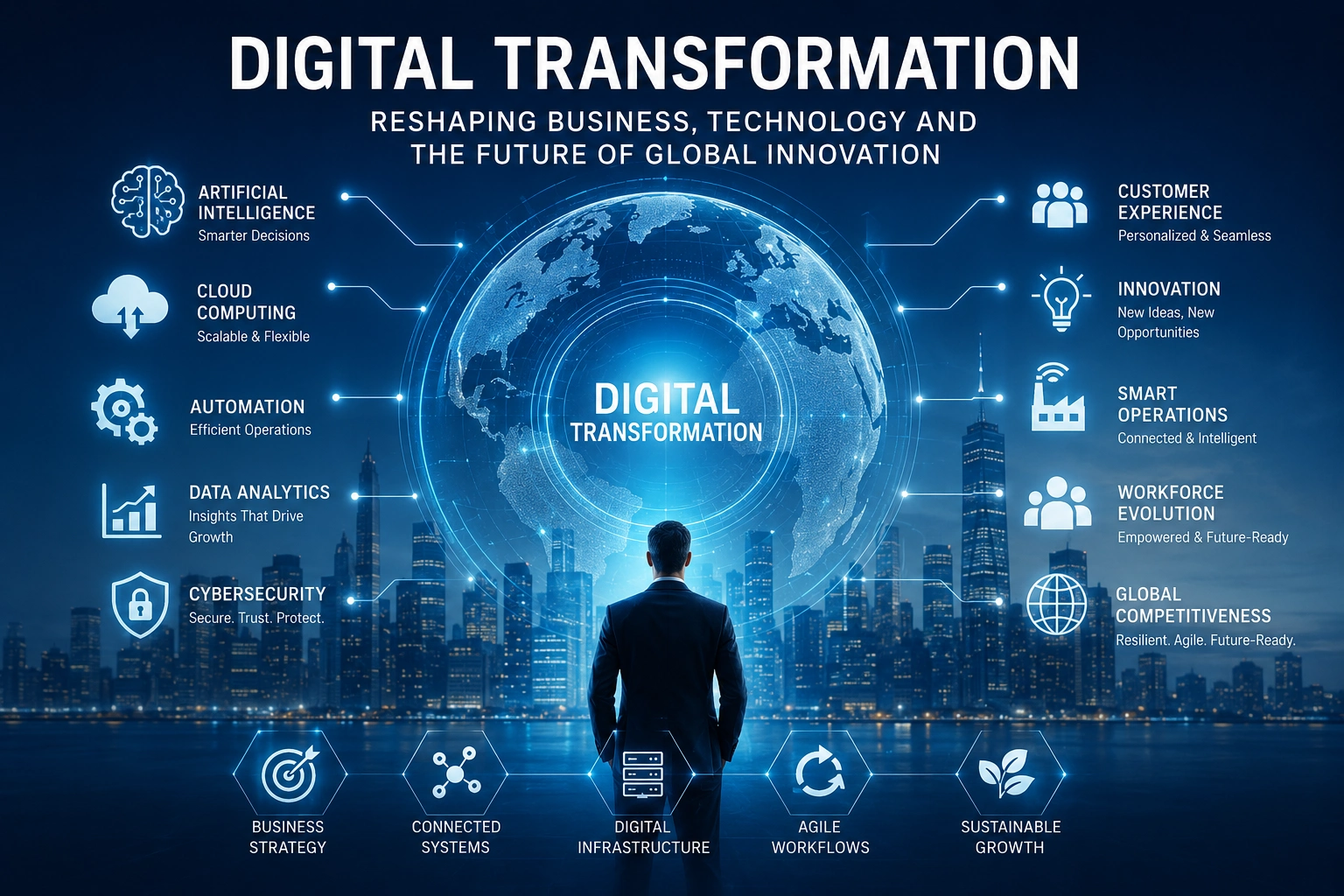
Digital transformation has evolved from a technology initiative into one of the defining business strategies of the modern era. Organizations are no longer competing solely through products, pricing, or scale. They increasingly compete through their ability to adapt, make better decisions, redesign customer experiences, modernize operations, and continuously innovate in response to changing markets.
The organizations leading digital transformation rarely succeed because they deploy more software than their competitors. They succeed because technology becomes embedded within leadership decisions, organizational culture, operational processes, and long-term strategic planning. Digital capabilities become part of how the business creates value rather than an isolated function managed by an IT department.
As industries become increasingly connected through cloud platforms, intelligent automation, artificial intelligence, data analytics, and digital infrastructure, transformation has become an ongoing capability instead of a one-time project. Companies that continuously evolve their operating models are often better positioned to respond to customer expectations, economic uncertainty, regulatory change, and emerging technologies.
This shift affects every sector—from manufacturing and healthcare to finance, education, government, and professional services—making digital transformation one of the most influential drivers of global innovation.
Digital Transformation Begins With Strategic Thinking, Not Technology
Technology enables transformation, but strategy determines whether transformation succeeds.
Organizations often misunderstand digital transformation by focusing first on software implementation, cloud migration, or automation tools. While these initiatives may improve efficiency, they rarely create lasting competitive advantage without broader organizational change.
Successful transformation starts with questions such as:
- How should the organization create value in the future?
- Which customer expectations are changing?
- Which business processes create unnecessary friction?
- Where can decisions become faster and more informed?
- Which capabilities will strengthen long-term competitiveness?
Technology then becomes the mechanism for executing strategic priorities rather than the objective itself.
This strategic mindset encourages continuous improvement instead of isolated modernization projects.
Reinventing Business Models for a Digital Economy
Digital transformation frequently changes how organizations generate revenue, deliver services, and build customer relationships.
Traditional industries increasingly supplement physical products with digital services, subscription models, connected platforms, predictive maintenance, personalized experiences, and data-driven decision making.
Many organizations no longer view digital channels as alternatives to physical operations. Instead, they integrate both into unified customer journeys.
This evolution allows businesses to:
- Respond more quickly to changing market conditions
- Develop new revenue opportunities
- Improve operational resilience
- Expand into new markets
- Build closer relationships with customers
Business model innovation has therefore become one of the strongest indicators of successful digital transformation.
Modern Enterprise Operations Are Built Around Connected Systems
Transformation increasingly removes operational silos that previously separated departments.
Instead of disconnected workflows, modern enterprises connect finance, operations, customer service, sales, logistics, procurement, and production through integrated digital platforms.
Connected operations improve organizational visibility by allowing information to move securely across departments.
This creates advantages such as:
- Faster operational decisions
- Reduced duplication of work
- Better resource planning
- Improved process consistency
- Greater organizational agility
Rather than replacing human expertise, integrated enterprise technology enables employees to make decisions with better information.
Customer Experience Has Become a Competitive Differentiator
Digital transformation has fundamentally changed customer expectations.
Consumers increasingly expect:
- Seamless digital interactions
- Consistent service across channels
- Personalized recommendations
- Faster response times
- Transparent communication
- Self-service capabilities when appropriate
Organizations that understand customer behavior through responsible data analysis can improve every stage of the customer journey without sacrificing trust.
Customer experience is therefore no longer managed solely by marketing or customer support. It has become a cross-functional organizational priority that influences product development, operations, technology, and leadership decisions.
Data Is Becoming an Organizational Decision Platform
Every organization generates operational, financial, customer, and market information.
Digital transformation increases the value of this information by improving how it is collected, organized, analyzed, and applied.
Modern decision-making increasingly combines:
- Business intelligence
- Data analytics
- Operational reporting
- Predictive modeling
- Real-time performance monitoring
Leaders gain greater visibility into changing conditions without relying solely on historical reports.
When governed responsibly, data becomes a strategic asset that supports planning, innovation, risk management, and continuous improvement.
Artificial Intelligence Is Accelerating Organizational Transformation
Artificial Intelligence is increasingly integrated into digital transformation strategies because it extends human decision-making rather than simply automating repetitive work.
Organizations apply AI across numerous business functions, including:
- Intelligent customer support
- Demand forecasting
- Document processing
- Quality control
- Fraud detection
- Predictive maintenance
- Workflow optimization
- Knowledge management
Successful implementation depends on clear governance, reliable data, transparent oversight, and alignment with organizational objectives.
Artificial intelligence delivers the greatest value when combined with experienced human judgment instead of replacing it.
Cloud Computing Enables Organizational Agility
Cloud computing has become a foundational component of digital transformation because it provides organizations with greater flexibility, scalability, and operational resilience.
Instead of relying exclusively on fixed infrastructure, businesses can adapt computing resources to changing operational requirements.
Cloud environments also support:
- Enterprise collaboration
- Software modernization
- Remote work
- Disaster recovery
- Global service delivery
- Continuous software improvement
For many organizations, cloud adoption represents an operational shift that supports long-term transformation rather than simply reducing infrastructure costs.
Automation Creates Capacity for Higher-Value Work
Automation is often associated with replacing manual tasks, but its broader value lies in enabling employees to focus on work requiring creativity, analysis, collaboration, and strategic thinking.
Organizations automate processes such as:
- Administrative workflows
- Document routing
- Financial reconciliation
- Inventory management
- Customer notifications
- Compliance monitoring
When implemented responsibly, automation improves consistency while allowing skilled professionals to dedicate more time to innovation and problem-solving.
Transformation therefore reshapes work instead of simply reducing effort.
Cybersecurity Must Evolve Alongside Digital Growth
As organizations expand their digital capabilities, cybersecurity becomes a strategic business requirement rather than an isolated technical function.
Digital transformation increases the number of connected systems, users, devices, applications, and external partnerships.
Protecting these environments requires attention to:
- Identity management
- Secure digital infrastructure
- Data protection
- Risk management
- Governance policies
- Employee awareness
- Business continuity planning
Trust remains one of the most valuable outcomes of effective cybersecurity.
Without confidence in digital systems, transformation initiatives struggle to achieve long-term success.
Workforce Transformation Is as Important as Technology Transformation
Technology alone cannot transform an organization.
Employees, leadership teams, and organizational culture determine whether transformation becomes sustainable.
Successful organizations invest in:
- Digital skills
- Continuous learning
- Cross-functional collaboration
- Leadership development
- Change management
- Knowledge sharing
Employees increasingly work alongside intelligent systems rather than competing against them.
Organizations that encourage adaptability often respond more effectively to technological change and evolving market conditions.
Innovation Becomes a Continuous Organizational Capability
Digital transformation encourages organizations to move beyond periodic innovation toward continuous experimentation and improvement.
Modern enterprises increasingly test ideas through shorter development cycles, customer feedback, iterative improvements, and collaborative decision-making.
Innovation management therefore shifts from isolated research projects to an organization-wide capability that supports long-term growth.
This approach enables businesses to identify opportunities earlier while reducing the risks associated with large-scale organizational change.
Industry Transformation Is Redefining Global Markets
Digital transformation affects industries differently, yet several common patterns continue to emerge.
Manufacturing
Smart manufacturing combines connected equipment, industrial automation, predictive maintenance, digital quality control, and operational analytics to improve production efficiency while increasing flexibility.
Manufacturers increasingly use digital technologies to strengthen supply chains, reduce downtime, improve resource utilization, and respond more quickly to changing customer demand.
Healthcare
Healthcare organizations continue adopting digital systems that improve clinical workflows, patient engagement, health information management, and care coordination.
Digital transformation supports more connected healthcare environments while helping professionals access information more efficiently and deliver better-informed care.
Financial Services
Banks, insurers, payment providers, and financial institutions increasingly modernize customer experiences while strengthening security, compliance, and operational efficiency.
Digital transformation enables faster service delivery, improved risk management, intelligent fraud detection, and more personalized financial experiences.
Education
Educational institutions continue expanding digital learning environments that support flexible access to educational resources, collaborative learning, and personalized instruction.
Technology complements educators by improving accessibility, communication, and knowledge delivery across diverse learning environments.
Public Services
Governments increasingly modernize public services through digital platforms that simplify citizen interactions, improve administrative efficiency, and enhance transparency.
Digital transformation helps public institutions deliver services more effectively while improving accessibility and operational responsiveness.
Leadership Determines the Pace of Transformation
Digital transformation succeeds when leadership establishes a clear organizational direction.
Executive teams increasingly focus on:
- Long-term strategic alignment
- Responsible technology adoption
- Investment prioritization
- Organizational resilience
- Risk governance
- Customer-centric decision making
Transformation requires continuous leadership engagement because technology, markets, regulations, and customer expectations continue evolving.
Organizations that treat transformation as a permanent capability generally adapt more effectively than those pursuing isolated modernization initiatives.
Measuring Transformation Beyond Technology
Successful organizations evaluate transformation through business outcomes rather than software deployments.
Indicators may include:
- Improved customer satisfaction
- Faster decision-making
- Operational efficiency
- Innovation capability
- Employee engagement
- Business resilience
- Organizational adaptability
- Sustainable growth
These outcomes demonstrate whether transformation is improving how the organization operates instead of simply expanding its technology portfolio.
The Future of Digital Transformation
Digital transformation will continue evolving as emerging technologies mature and organizations rethink how they create value.
Artificial intelligence, advanced analytics, cloud-native platforms, automation, connected infrastructure, cybersecurity, and intelligent enterprise systems will increasingly work together rather than as separate initiatives.
Future transformation strategies are likely to place even greater emphasis on responsible innovation, resilient operations, trusted digital ecosystems, and human-centered technology adoption.
Organizations that continuously strengthen their digital capabilities by adopting modern digital technologies while maintaining strategic discipline will be better prepared for future economic, technological, and societal change.
Digital transformation is therefore not a destination reached after implementing new technologies. It is an ongoing organizational capability that enables businesses, institutions, and governments to adapt, innovate, and remain competitive in an increasingly connected global economy.
Frequently Asked Questions
Why do many digital transformation initiatives fail?
Many initiatives struggle because organizations prioritize technology implementation over organizational strategy, leadership alignment, workforce readiness, and process redesign. Sustainable transformation requires coordinated changes across people, operations, governance, and technology.
Is digital transformation only relevant for large enterprises?
No. Organizations of every size can benefit from digital transformation. Small and medium-sized businesses often adopt digital strategies that improve efficiency, strengthen customer relationships, and support sustainable growth while remaining aligned with their available resources.
How is digital transformation different from digitalization?
Digitalization refers to converting processes or information into digital formats and workflows. Digital transformation is broader, involving strategic organizational change that reshapes business models, operations, culture, customer experiences, and long-term competitiveness.
How long does digital transformation take?
Digital transformation has no fixed endpoint. Organizations continuously adapt to new technologies, evolving customer expectations, regulatory requirements, and changing market conditions. Successful transformation is an ongoing process of improvement rather than a one-time project.