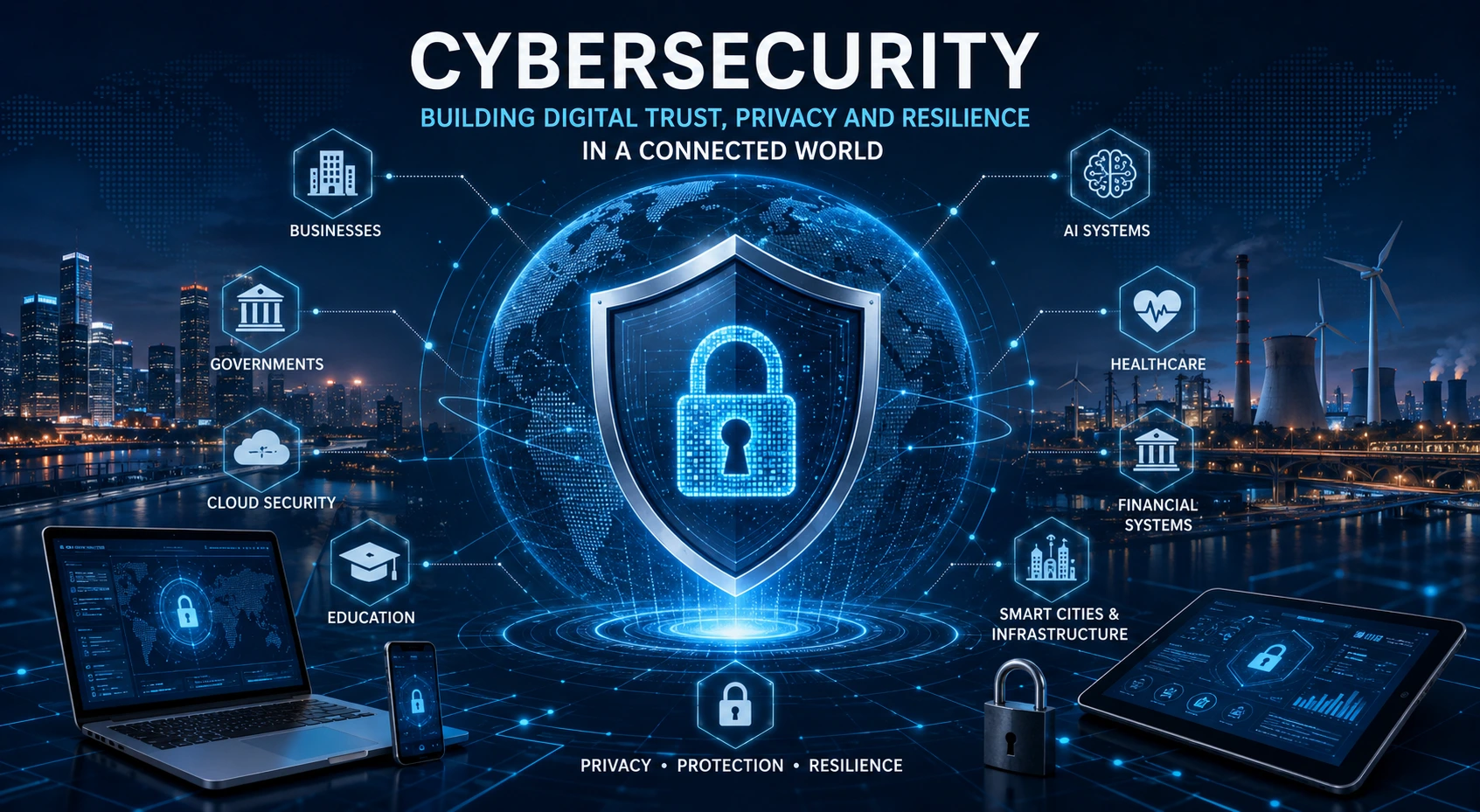
Digital transformation has reshaped nearly every aspect of modern society. Governments deliver public services online, businesses operate across global cloud platforms, financial transactions occur in seconds, healthcare depends on connected medical systems, and artificial intelligence increasingly supports everyday decisions. This interconnected environment has created extraordinary opportunities—but it has also made cybersecurity one of the defining pillars of modern civilization.
Cybersecurity is no longer limited to defending computer networks. It underpins digital trust, protects economic stability, preserves privacy, supports innovation, and enables organizations to operate confidently in an increasingly connected world. As technology continues to evolve, security becomes less about preventing every incident and more about building resilient systems that can withstand disruption, adapt to emerging risks, and maintain public confidence.
Organizations that view cybersecurity as a strategic business capability rather than a technical obligation are better positioned to innovate responsibly, protect stakeholders, and sustain long-term growth.
Cybersecurity as the Foundation of Digital Trust
Every digital interaction depends on confidence. Customers expect their personal information to remain protected, employees require secure access to workplace systems, businesses rely on accurate data, and governments must safeguard public services from disruption.
Cybersecurity creates the conditions that make these expectations possible.
Digital trust develops when people believe that information remains accurate, confidential, and available whenever it is needed. Security policies, governance frameworks, identity controls, and continuous monitoring all contribute to that confidence without becoming visible to everyday users.
As organizations expand their digital services, trust increasingly becomes a competitive advantage rather than merely a compliance requirement.
Why Security Strategy Has Become a Boardroom Priority
Cybersecurity decisions now influence business continuity, corporate reputation, regulatory compliance, customer confidence, operational resilience, and investment planning.
Executive leadership increasingly treats cybersecurity as part of enterprise risk management because security failures affect every department rather than only information technology teams.
Modern organizations consider questions such as:
- Which critical services must remain available during disruption?
- How should sensitive information be governed across cloud environments?
- What level of cyber risk aligns with business objectives?
- How can security support innovation instead of slowing it down?
These conversations demonstrate that cybersecurity has become a strategic discipline embedded within organizational planning.
Building Resilience Instead of Chasing Perfect Security
Absolute protection is unrealistic within today’s digital ecosystem. New technologies, evolving threats, supply chain dependencies, and expanding digital services continually reshape organizational risk.
Cyber resilience focuses on maintaining operations before, during, and after security incidents.
A resilient organization emphasizes:
- Preparation
- Early detection
- Coordinated response
- Rapid recovery
- Continuous improvement
Rather than measuring success solely by preventing attacks, resilient organizations evaluate how effectively they preserve essential services under pressure.
This approach supports operational stability while strengthening long-term organizational confidence.
Privacy and Data Protection as Essential Business Responsibilities
Information has become one of the world’s most valuable assets. Personal records, intellectual property, financial information, healthcare data, research, and operational insights all require responsible stewardship.
Privacy and cybersecurity work together but serve different purposes.
Privacy establishes how information should be collected, used, stored, and shared responsibly. Cybersecurity provides the technical and organizational protections that help enforce those privacy commitments.
Organizations that integrate privacy into security planning strengthen customer relationships while demonstrating accountability and responsible governance.
As digital ecosystems continue expanding, protecting information becomes both an ethical obligation and a business necessity.
Identity Has Become the New Security Perimeter
Traditional network boundaries continue to fade as remote work, cloud platforms, mobile devices, and distributed applications become standard operating environments.
Identity now serves as one of the most important security controls.
Modern identity management emphasizes:
- Verified authentication
- Appropriate access privileges
- Continuous verification
- Lifecycle management
- Secure administration
Granting users only the access required for their responsibilities reduces unnecessary exposure while improving operational control.
Identity-centered security also supports regulatory compliance and strengthens organizational governance.
Cloud Security Requires Shared Responsibility
Cloud computing has transformed how organizations build digital services, manage infrastructure, and scale operations.
Moving workloads to cloud platforms does not eliminate security responsibilities. Instead, it changes how those responsibilities are shared between service providers and customers.
Effective cloud security depends on:
Governance Before Deployment
Organizations should establish clear policies for data classification, access management, workload placement, and regulatory obligations before migrating critical systems.
Continuous Visibility
Cloud environments evolve rapidly. Ongoing monitoring helps organizations understand configuration changes, user activity, and operational risks without relying solely on periodic reviews.
Secure Operational Practices
Security becomes stronger when integrated into deployment processes, infrastructure management, software development, and ongoing maintenance rather than being introduced after systems are already operational.
Zero Trust Architecture Reflects the Reality of Modern Networks
The traditional assumption that everything inside a network can be trusted is no longer practical.
Zero Trust Architecture encourages organizations to continuously verify users, devices, applications, and workloads regardless of their location.
Its guiding principles include:
- Never assume trust automatically.
- Verify identities continuously.
- Limit access according to business need.
- Monitor activity throughout the digital environment.
Rather than representing a single product, Zero Trust is an evolving security strategy that aligns with today’s distributed computing environments.
Artificial Intelligence Expands Both Opportunity and Responsibility
Artificial Intelligence is transforming cybersecurity in meaningful ways.
Security teams increasingly use AI to improve detection, automate repetitive processes, identify unusual behavior, and strengthen operational awareness.
At the same time, organizations deploying AI systems must also consider:
- Data governance
- Model integrity
- Responsible automation
- Privacy protection
- Secure development practices
- Human oversight
AI introduces new opportunities for improving resilience while requiring thoughtful governance that balances innovation with accountability.
Protecting Critical Infrastructure Supports National Stability
Essential services increasingly depend on interconnected digital systems.
Energy networks, transportation systems, telecommunications, healthcare services, financial institutions, water utilities, and emergency response organizations all rely upon secure digital infrastructure.
Cybersecurity within these sectors extends beyond protecting information.
It supports:
- Public safety
- Economic continuity
- National resilience
- Essential public services
- Supply chain stability
Strong collaboration between public institutions, private organizations, and infrastructure operators strengthens collective resilience across society.
Financial Systems Depend on Continuous Confidence
Modern finance operates through highly interconnected digital ecosystems.
Banks, payment platforms, investment services, insurance providers, and digital commerce platforms all depend on reliable cybersecurity to maintain confidence in financial transactions.
Security strategies support:
- Transaction integrity
- Identity verification
- Fraud prevention
- Operational continuity
- Regulatory compliance
- Customer confidence
Maintaining trust within financial systems remains essential for broader economic stability.
Healthcare Security Protects More Than Information
Healthcare organizations manage some of the world’s most sensitive information while supporting life-critical services.
Cybersecurity in healthcare helps protect:
- Patient records
- Clinical systems
- Medical devices
- Hospital operations
- Research environments
- Healthcare supply chains
Because healthcare depends upon uninterrupted service delivery, resilience planning is just as important as protecting confidential information.
Reliable cybersecurity supports both patient safety and organizational continuity.
Education Requires Secure Digital Learning Environments
Educational institutions have become increasingly digital.
Universities, schools, and research organizations support online learning, collaborative research, digital libraries, cloud platforms, and administrative systems that serve large communities.
Cybersecurity within education promotes:
- Protection of student information
- Secure academic collaboration
- Research integrity
- Reliable digital learning
- Responsible technology adoption
As educational technology continues evolving, security becomes a foundational element of accessible and trusted learning environments.
Smart Cities Depend on Secure Digital Infrastructure
Cities increasingly rely on connected technologies to improve transportation, energy management, environmental monitoring, public safety, and municipal services.
These interconnected systems create efficiencies while expanding the importance of coordinated cybersecurity planning.
Effective governance includes:
- Secure infrastructure planning
- Risk management
- Cross-sector collaboration
- Privacy considerations
- Operational resilience
- Incident preparedness
Building secure smart cities requires integrating cybersecurity into long-term urban development rather than treating it as an afterthought.
Connected Devices Expand the Responsibility for Security
Internet-connected devices continue transforming homes, workplaces, manufacturing, healthcare, logistics, and public infrastructure.
Every connected device potentially becomes part of a larger digital ecosystem.
Organizations should prioritize:
- Secure product design
- Lifecycle management
- Software maintenance
- Identity controls
- Device visibility
- Responsible deployment
As connected environments expand, security increasingly begins during design rather than after deployment.
Compliance Should Strengthen Governance, Not Replace It
Regulatory frameworks help organizations establish consistent approaches to protecting information and managing digital risk.
However, compliance alone does not guarantee strong cybersecurity.
Effective organizations use regulatory obligations as a baseline while building broader governance programs that emphasize:
- Risk management
- Executive accountability
- Security culture
- Continuous improvement
- Business resilience
When governance extends beyond minimum requirements, cybersecurity becomes a strategic capability rather than a checklist exercise.
Business Continuity Connects Security With Organizational Stability
Every organization depends on its ability to continue operating during unexpected events.
Cybersecurity supports business continuity by helping organizations prepare for disruption while protecting essential operations.
Business continuity planning considers:
- Critical business functions
- Operational dependencies
- Communication planning
- Recovery priorities
- Organizational coordination
This integration ensures that security contributes directly to organizational resilience rather than functioning as an isolated technical discipline.
Security Culture Is Built Through Everyday Decisions
Technology alone cannot create resilient organizations.
Employees, leadership teams, partners, suppliers, and customers all influence cybersecurity outcomes through everyday decisions.
Organizations with strong security cultures encourage:
- Clear accountability
- Responsible technology use
- Continuous learning
- Transparent communication
- Leadership engagement
- Shared responsibility
When security becomes part of organizational culture, resilience strengthens across every business function.
The Future of Cybersecurity Will Be Defined by Trust
Digital ecosystems will continue expanding through artificial intelligence, cloud computing, intelligent infrastructure, connected devices, automation, and emerging technologies.
Future cybersecurity strategies will increasingly prioritize:
- Adaptive risk management
- Privacy by design
- Secure digital infrastructure
- Responsible AI governance
- Cross-sector collaboration
- Cyber resilience
- Sustainable digital trust
Organizations that embed security into innovation from the beginning will be better equipped to support economic growth, technological advancement, and public confidence in an increasingly connected world.
Frequently Asked Questions
Why is cybersecurity considered a business strategy rather than only an IT function?
Cybersecurity influences operational continuity, customer confidence, regulatory obligations, organizational reputation, and long-term resilience. Because these outcomes affect the entire organization, cybersecurity has become a strategic leadership responsibility rather than solely a technical discipline.
How does cybersecurity contribute to digital trust?
Cybersecurity helps protect information, verifies identities, supports reliable digital services, and maintains the integrity of systems. These protections enable individuals, businesses, and governments to engage confidently in digital environments.
What is cyber resilience?
Cyber resilience is an organization’s ability to prepare for, respond to, recover from, and adapt after cybersecurity incidents while maintaining essential operations and minimizing disruption.
Why is Zero Trust becoming more important?
As organizations increasingly rely on cloud services, remote work, and distributed applications, traditional network boundaries become less effective. Zero Trust emphasizes continuous verification of users, devices, and systems regardless of location.
How does cybersecurity support the global digital economy?
Secure digital infrastructure enables reliable financial transactions, international commerce, cloud services, healthcare systems, education platforms, critical infrastructure, and digital communication. Strong cybersecurity helps sustain confidence in these interconnected systems.