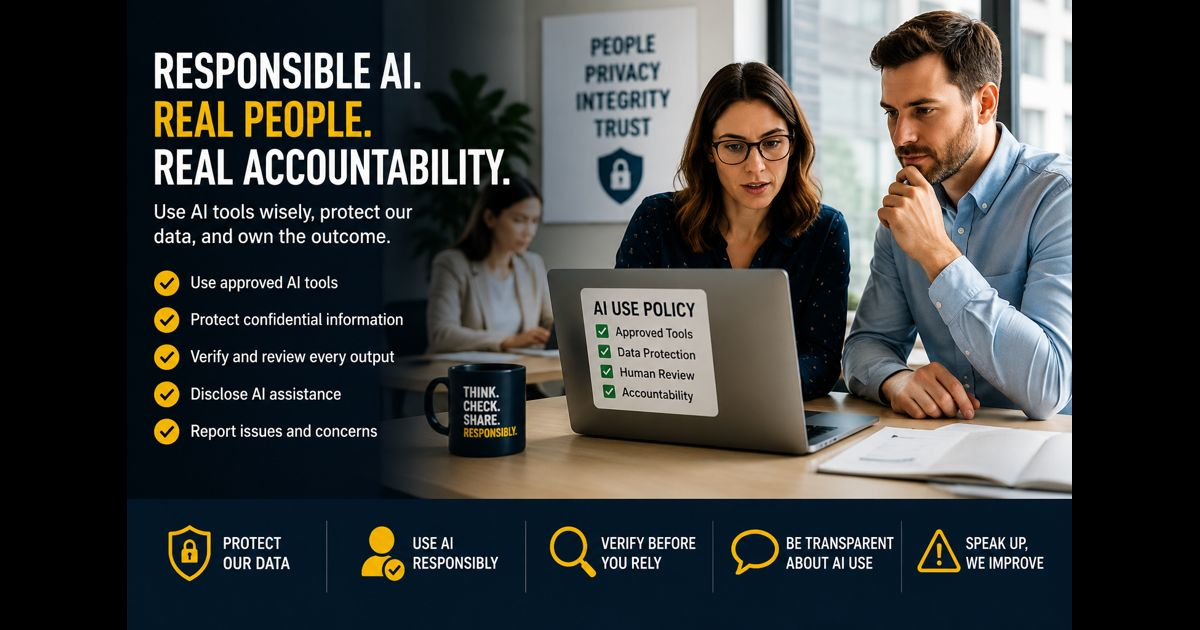
An AI acceptable use policy for employees sets clear boundaries for using artificial intelligence at work. It explains which tools are approved, what information may be entered, when human review is required, and who is accountable for the final result.
A useful policy does not treat AI as either a shortcut or a threat. It recognizes that AI can help with routine work while protecting confidential information, preserving professional judgment, and preventing employees from relying on inaccurate or biased outputs.
This guide explains the essential parts of an employee-facing AI policy and provides a practical model organizations can adapt to their own risks, responsibilities, and industry requirements.
What an employee AI acceptable use policy should do
An acceptable use policy is a day-to-day guide. It should answer the questions employees face before they open an AI assistant, upload a document, or use AI-generated work.
A clear policy should establish:
- Which AI tools are approved for business use
- Which types of work may use AI assistance
- What information must never be entered into an AI system
- When an employee must verify, edit, disclose, or obtain approval for AI-supported work
- Which uses are prohibited
- How concerns, mistakes, or possible data exposure must be reported
The policy should apply to employees, contractors, temporary staff, and anyone using AI on behalf of the organization. It should also address both company-provided accounts and personal AI accounts used for work.
Begin with approved tools, not vague permission
A policy that simply says “use AI responsibly” leaves too much room for interpretation. Employees need to know which platforms have been reviewed and what each one is approved to handle.
An approved-tools register can list:
- The tool name and approved version
- The business purpose it supports
- The permitted user groups
- Data restrictions
- Required settings, such as enterprise accounts or disabled training controls
- The business owner responsible for reviewing continued use
Tools should not be approved permanently by default. Product features, data-handling terms, integrations, and security controls can change. Regular review keeps the policy aligned with the actual tool environment.
Employees should not connect unapproved AI services to company systems, browser extensions, shared drives, customer platforms, code repositories, or workplace messaging tools without authorization.
Set practical data boundaries
The most important section of an AI acceptable use policy is often the simplest: employees must know what they may and may not put into a prompt.
Public or consumer AI tools should never receive confidential or personally identifiable information unless the organization has specifically approved that use and put appropriate safeguards in place.
Information that normally requires strict protection includes:
- Customer, client, patient, student, or employee personal information
- Passwords, access tokens, API keys, and security details
- Financial records, payment information, and non-public business results
- Contracts, legal advice, litigation material, and privileged communications
- Source code, product roadmaps, technical designs, and unreleased research
- Trade secrets, internal strategy, pricing, and acquisition information
- Sensitive health, biometric, identity, or government-issued information
A safer approach is to use fictional examples, redacted material, or anonymized data when AI assistance is genuinely useful. Removing a name alone is not always enough; a combination of details can still identify a person, customer, or organization.
Strong cybersecurity practice depends on limiting unnecessary exposure before data leaves a controlled system.
Allow useful work while protecting judgment
AI can support many low-risk tasks when employees understand its limits. Permitted uses may include brainstorming, outlining, plain-language rewrites, meeting-note organization, translation review, drafting non-sensitive internal material, or explaining a public technical concept.
Permission should always depend on the task, the data involved, and the possible effect of an error.
For example, an employee may use an approved tool to suggest a first draft of a public-facing announcement. The employee should still check facts, tone, dates, names, accessibility, and brand accuracy before publication. AI assistance does not transfer responsibility for the final work.
Policies work best when they make this principle explicit:
Employees remain responsible for the accuracy, appropriateness, legality, and quality of work submitted, shared, published, or acted upon.
That standard applies whether the output is a report, email, code suggestion, customer response, presentation, analysis, or creative work.
Require human review before important decisions
AI output can sound confident while containing errors, missing context, fabricated citations, outdated information, or unfair assumptions. A policy should require meaningful human review before AI-supported material is used for anything significant.
Human review should include checking:
- Factual accuracy and source reliability
- Calculations, dates, names, and quotations
- Confidentiality and data-protection obligations
- Copyright, licensing, and attribution requirements
- Discriminatory, exclusionary, unsafe, or misleading content
- Whether the output fits the audience and business context
Extra safeguards are needed when AI influences decisions about people. Employees should not use AI as the sole basis for hiring, promotion, pay, discipline, performance evaluation, termination, benefits, admission, credit, healthcare, or other high-impact outcomes.
Where AI supports an employment-related process, the organization should define the decision-maker, document the role of the tool, assess whether the process treats groups fairly, and preserve a meaningful human review process. Automated recommendations should inform judgment, not replace it.
Make disclosure proportionate to the work
Disclosure does not need to become a bureaucratic exercise. It should be required when AI materially contributes to work that others may reasonably assume was independently researched, created, assessed, or verified.
Examples may include:
- Publishing substantial AI-assisted content externally
- Providing AI-generated analysis to a client or customer
- Using AI in a decision that affects an employee or applicant
- Producing a report where evidence, authorship, or methodology matters
- Using synthetic images, audio, or video that could be mistaken for real material
The policy should state who must be informed, how disclosure should be made, and when it is unnecessary. For routine administrative assistance that is fully reviewed by the employee, a formal disclosure may not be needed. The aim is transparency where it matters, not friction where it does not.
Clearly prohibit harmful or deceptive uses
A policy should name prohibited conduct directly. Employees must not use AI to:
- Upload restricted information to an unapproved service
- Create deceptive, harassing, discriminatory, or unlawful content
- Impersonate a colleague, customer, executive, or external party
- Generate false records, fabricated evidence, or misleading citations
- Bypass security controls or access restrictions
- Make binding decisions without required human review
- Copy third-party content in a way that violates legal, contractual, or licensing obligations
- Build or deploy an AI feature without required technical, security, or legal approval
- Conceal a material AI error, data exposure, or unauthorized use
The policy should also make clear that an employee is not expected to hide a mistake. Early reporting allows the organization to contain risk, correct records, and improve guidance.
Give employees a simple escalation path
Employees often make poor choices when they do not know whom to ask. A good policy includes a straightforward route for questions and approvals.
Questions about ordinary work use may go to a manager or designated AI owner. Questions involving sensitive data, contracts, security, regulated activity, customer information, or employment decisions should go to the appropriate privacy, security, legal, compliance, or human-resources team.
Employees should promptly report:
- An accidental upload of protected data
- Use of an unapproved tool for work
- A suspected security issue involving an AI service
- Harmful, inaccurate, or biased output that affected work
- A request to use AI in a high-impact decision
Reporting should be treated as responsible conduct. The objective is to understand what happened and prevent repeat issues, not to create a culture of concealment.
Train through realistic examples
Employees are more likely to follow a policy when they can apply it to real situations. Training should use examples relevant to each department.
A marketing employee might learn how to use AI for campaign ideas without entering client strategy or unpublished performance data. A developer might learn when code can be submitted to an approved assistant and when proprietary code must remain within controlled tools. A human-resources team might learn why an AI-written job description still needs review for accuracy and fairness.
Short, recurring training is often more effective than one long session. It should cover approved tools, data handling, verification, disclosure, prohibited uses, and reporting. New employees and contractors should receive the guidance before they gain access to relevant systems.
Review the policy as tools and risks change
AI policies should be living documents. New capabilities can introduce new risks, while some restrictions may become unnecessary after stronger controls are adopted.
A regular review can assess:
- Whether the approved-tools list remains accurate
- New data-handling or training practices from vendors
- Employee questions and recurring mistakes
- Security incidents or reported near misses
- Changes in contracts, regulations, or internal standards
- Whether high-impact uses require additional safeguards
The review should involve the people who understand the work, not only technical teams. Information security, privacy, legal, human resources, procurement, communications, and operational leaders may all identify risks that a single department would miss.
Reliable oversight also depends on Information Quality. AI-supported work is only as dependable as the facts, context, review, and accountability behind it.
A concise employee policy model
The following language can serve as a starting point for an organization’s own policy:
Purpose: This policy establishes requirements for responsible use of artificial intelligence tools in work activities.
Scope: The policy applies to employees, contractors, temporary staff, and other authorized users of organization systems and information.
Approved use: Users may use only approved AI tools for authorized business purposes and must follow the data restrictions assigned to each tool.
Protected information: Users must not enter confidential, personal, regulated, privileged, proprietary, or security-sensitive information into an AI tool unless the organization has expressly approved the use and implemented appropriate safeguards.
Human accountability: AI-generated output must be reviewed for accuracy, appropriateness, bias, security, and legal or contractual compliance before it is used. Users remain responsible for final work product and decisions.
High-impact decisions: AI must not be the sole basis for decisions affecting employment, access to services, finances, health, safety, legal rights, or other significant interests.
Disclosure: Users must disclose material AI assistance when required by organizational standards, a customer agreement, law, or the nature of the work.
Reporting: Users must promptly report suspected policy violations, data exposure, security concerns, or harmful AI output through the organization’s designated reporting channel.
Enforcement: Violations may lead to restricted access, additional training, corrective action, or other measures consistent with organizational policy and applicable law.
Frequently asked questions
Can employees use personal AI accounts for work?
Not unless the organization’s policy explicitly allows it. Personal accounts may have different data settings, retention practices, security controls, and contractual protections than approved business accounts.
Is AI-generated content acceptable if an employee edits it?
It can be, provided the use is allowed, no restricted information was entered, and the employee verifies the final content. Editing alone does not correct factual errors, legal issues, biased framing, or misleading claims.
Should employees disclose every use of AI?
No. Disclosure should be required when AI materially shapes work where authorship, methodology, reliability, or decision-making matters. The policy should define those situations clearly.
Who is responsible if AI output is wrong?
The employee and organization remain responsible for work they approve, send, publish, or act on. AI tools can assist with tasks, but they do not assume professional, legal, ethical, or operational responsibility.
Final thoughts
An effective AI acceptable use policy gives employees practical permission to use helpful tools without leaving them to guess where the boundaries are. Clear approved tools, firm data protections, human review, proportionate disclosure, and simple reporting channels create a workplace where AI can support better work without weakening accountability.