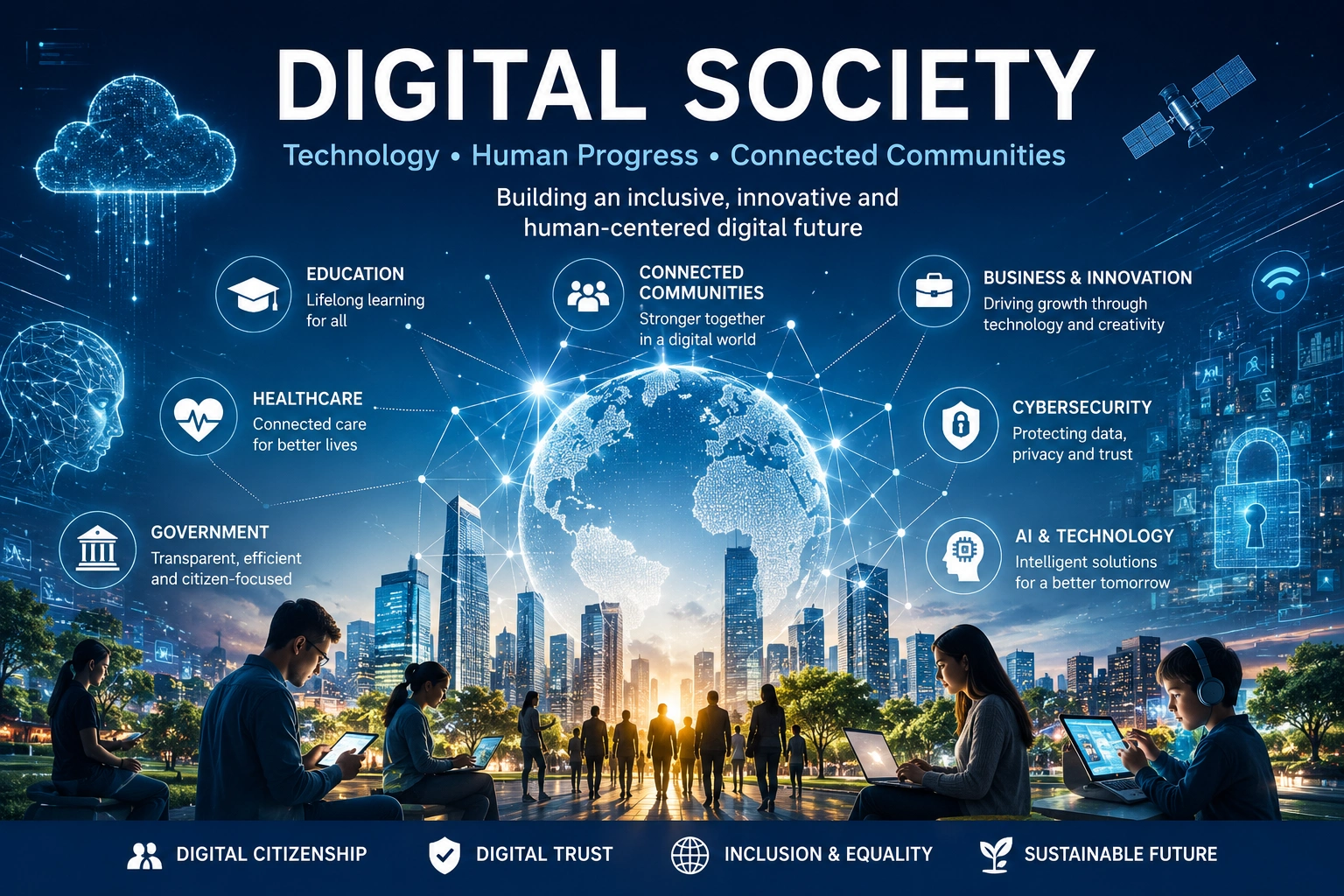
Digital society is no longer a vision of the future. It is the environment in which people learn, work, communicate, receive healthcare, access public services, build businesses, and participate in civic life. Every connected device, digital platform, intelligent system, and online community contributes to a broader transformation that extends beyond technology itself. The defining question is no longer whether society will become more digital, but how digital progress can continue to strengthen human well-being, opportunity, and trust.
Unlike earlier periods of technological adoption that focused primarily on infrastructure or automation, today’s digital society depends on the quality of relationships between people, institutions, and technology. Connectivity alone does not create progress. Long-term success depends on inclusive design, ethical governance, reliable information, secure digital environments, and systems that serve communities rather than simply increasing efficiency.
As governments, educational institutions, healthcare providers, businesses, and citizens become increasingly interconnected, digital society emerges as a foundation for innovation, collaboration, and sustainable development.
Technology as Social Infrastructure
Modern technology functions as an essential layer of social infrastructure. Digital networks support communication, commerce, education, transportation, emergency response, scientific collaboration, and public administration. Much like roads or utilities shaped industrial societies, digital infrastructure now enables daily social and economic activity.
Reliable internet connectivity, cloud services, secure data exchange, intelligent software, and digital platforms allow individuals and organizations to collaborate across geographic boundaries. These systems reduce barriers to participation while creating new opportunities for entrepreneurship, research, creativity, and lifelong learning.
As technology becomes increasingly embedded in public life, resilience, accessibility, and security become equally important as innovation.
Human-Centered Design Defines Sustainable Progress
Technology delivers its greatest value when it strengthens human capabilities rather than replacing human judgment. Human-centered digital development prioritizes usability, accessibility, transparency, and meaningful outcomes instead of technological complexity alone.
Successful digital services recognize that users represent different ages, cultures, abilities, educational backgrounds, and levels of digital confidence. Designing for this diversity creates systems that are easier to understand, more inclusive, and more trustworthy.
Whether developing government portals, educational platforms, healthcare systems, or workplace technologies, organizations increasingly recognize that digital success depends on improving human experiences rather than simply deploying new software.
Digital Citizenship Beyond Online Participation
Being part of a digital society requires more than internet access. Digital citizenship reflects the knowledge, responsibilities, and ethical behavior needed to participate confidently in connected environments.
Responsible digital citizens understand how to:
- Evaluate online information critically.
- Protect personal privacy.
- Respect intellectual property.
- Engage respectfully in public discussions.
- Recognize misinformation.
- Maintain cybersecurity awareness.
- Contribute positively to online communities.
Digital citizenship also encourages individuals to understand how algorithms, artificial intelligence, and digital platforms influence public conversations, economic opportunities, and democratic participation.
These capabilities strengthen both individual resilience and collective trust.
Connected Communities Create New Forms of Collaboration
Digital communities increasingly complement traditional physical communities rather than replacing them.
Local governments coordinate emergency responses through digital platforms. Volunteers organize community initiatives online. Researchers collaborate internationally. Businesses work with distributed teams across continents. Families remain connected regardless of physical distance.
These connected communities create new opportunities for:
- Knowledge sharing
- Civic participation
- Professional networking
- Cultural exchange
- Innovation partnerships
- Lifelong education
The most resilient communities successfully combine digital connectivity with strong human relationships, recognizing that technology should enhance social cohesion rather than weaken it.
Education Evolves into Continuous Digital Learning
Education within a digital society extends far beyond classrooms and universities.
Professionals continuously update their skills through online learning platforms. Educational institutions increasingly integrate digital resources alongside traditional instruction. Remote collaboration tools enable global academic partnerships, while digital libraries improve access to knowledge regardless of geographic location.
Equally important is the development of digital competencies that prepare individuals to navigate an evolving technological landscape. Critical thinking, media literacy, responsible technology use, and information evaluation become foundational skills alongside traditional academic disciplines.
Lifelong learning becomes a defining characteristic of modern digital societies because technological change continues throughout every stage of professional and personal life.
Healthcare Becomes More Connected and Preventive
Healthcare increasingly benefits from secure digital ecosystems that improve coordination between patients, healthcare professionals, and medical institutions.
Electronic health records, remote consultations, digital monitoring technologies, and secure information sharing can improve continuity of care while expanding access for underserved populations.
The future of digital healthcare also emphasizes prevention through better health information, earlier interventions, and more coordinated care pathways.
However, healthcare innovation depends on maintaining strict standards for privacy, cybersecurity, transparency, and ethical data management to preserve patient trust.
Digital Government Strengthens Public Services
Governments increasingly use digital platforms to improve accessibility, efficiency, and public engagement.
Citizens can access permits, tax services, licensing, public information, healthcare resources, educational services, and administrative processes through secure digital systems.
Well-designed digital government services reduce administrative complexity while improving transparency and responsiveness.
The long-term objective extends beyond digitizing paperwork. Effective digital governance creates institutions that are more accessible, accountable, and capable of responding to evolving societal needs.
Business Operates Within Connected Digital Ecosystems
Modern businesses no longer compete solely through products or services. Competitive advantage increasingly depends on digital capabilities that support innovation, customer experience, operational efficiency, and organizational adaptability.
Digital society reshapes every stage of business activity:
- Customer engagement
- Supply chain management
- Remote collaboration
- Product development
- Knowledge management
- Data-driven decision making
- International market access
Organizations that successfully embrace digital transformation recognize that technology should support long-term strategic objectives rather than becoming an objective itself.
Business resilience increasingly depends on continuous learning, adaptable leadership, and responsible innovation.
Information Quality Determines Public Confidence
Digital societies generate unprecedented volumes of information. The challenge is no longer information scarcity but information quality.
Reliable decision-making requires credible sources, transparent editorial standards, and effective methods for verifying accuracy.
Information quality influences healthcare decisions, financial planning, public policy, education, scientific understanding, and civic participation.
This makes media literacy an essential capability for both individuals and institutions. Citizens who evaluate sources critically contribute to healthier public discourse and stronger democratic processes.
Editorial responsibility therefore becomes increasingly valuable within digital knowledge ecosystems.
Digital Trust Supports Every Connected System
Technology cannot deliver lasting value without trust.
Digital trust develops through consistent protection of privacy, cybersecurity, ethical governance, transparency, and accountability.
People are more willing to adopt digital services when they understand:
- How information is collected.
- Why data is used.
- How privacy is protected.
- Who remains accountable for decisions.
- What safeguards exist against misuse.
Organizations that prioritize trust strengthen customer relationships, institutional credibility, and long-term sustainability.
Trust therefore becomes both a social value and a competitive advantage within digital economies.
Artificial Intelligence Expands Human Capability
Artificial intelligence is becoming one of the defining technologies shaping digital society.
AI increasingly supports healthcare diagnostics, scientific research, education, accessibility, customer service, cybersecurity, business operations, and knowledge discovery.
Its long-term value depends on responsible implementation that maintains transparency, fairness, human oversight, and accountability.
Responsible AI complements human expertise instead of replacing human responsibility. Organizations that deploy AI ethically strengthen public confidence while encouraging sustainable innovation.
Digital Inclusion Determines Shared Progress
A truly connected society cannot leave portions of the population behind.
Digital inclusion requires more than broadband availability. It also depends upon:
- Affordable access
- Accessible technologies
- Inclusive design
- Digital education
- Multilingual services
- Support for individuals with disabilities
- Opportunities for lifelong skill development
Reducing digital inequality enables broader participation in education, employment, entrepreneurship, healthcare, and civic life.
Inclusive digital development ultimately strengthens both economic resilience and social cohesion.
Cybersecurity Protects Everyday Society
Cybersecurity is often associated with technical systems, yet its social importance extends much further.
Individuals trust digital banking, healthcare, education, communication, and government services because secure systems protect identities, financial information, and confidential data.
As societies become increasingly interconnected, cybersecurity evolves into a shared responsibility involving governments, businesses, technology providers, educational institutions, and individual users.
Strong cybersecurity practices help preserve confidence across every digital interaction.
Innovation Depends on Collaboration Across Institutions
Digital innovation rarely emerges from isolated organizations.
Universities, businesses, startups, governments, researchers, nonprofit organizations, and technology providers increasingly collaborate to solve complex challenges.
Cloud computing, artificial intelligence, AI search technologies, secure data exchange, and digital collaboration platforms accelerate innovation by connecting expertise across disciplines.
The future belongs to innovation ecosystems where knowledge flows efficiently between institutions while maintaining ethical standards and public trust.
Building Institutions That Can Adapt
Technological change will continue to reshape societies, but adaptability has become more important than predicting specific innovations.
Educational institutions must prepare students for continuous learning.
Businesses must evolve alongside changing markets.
Governments must modernize public services while protecting citizens’ rights.
Healthcare systems must integrate innovation without compromising safety.
Media organizations must strengthen information quality amid rapidly expanding digital content.
Institutions that develop adaptive cultures will remain resilient regardless of future technological developments.
The Future of Digital Society
The next stage of digital society will be shaped less by individual technologies than by the quality of connections between technology, institutions, and people.
Future progress will likely emphasize trusted artificial intelligence, resilient digital infrastructure, secure cross-border collaboration, intelligent public services, sustainable innovation, and inclusive access to knowledge.
Rather than measuring success by technological sophistication alone, mature digital societies will evaluate whether innovation improves education, healthcare, economic opportunity, civic participation, environmental sustainability, and overall quality of life.
Technology will continue to evolve rapidly, but enduring progress will depend on preserving human values at the center of digital transformation.
Frequently Asked Questions
Why is digital society important for long-term development?
Digital society strengthens collaboration between people, institutions, and technology, enabling more accessible education, healthcare, government services, business innovation, and knowledge sharing while supporting sustainable economic and social development.
How does digital society differ from digital transformation?
Digital transformation describes how organizations adopt technology to improve operations and services. Digital society is broader, encompassing the long-term relationship between technology, communities, institutions, culture, governance, and everyday human interaction.
What role does digital trust play in connected communities?
Digital trust encourages individuals and organizations to use digital services confidently by promoting transparency, cybersecurity, responsible data practices, privacy protection, and accountable governance.
Why is digital inclusion essential?
Digital inclusion ensures that technological progress benefits everyone by expanding access to digital infrastructure, education, accessible technologies, and opportunities for participation regardless of location, age, income, or ability.
How will digital society continue to evolve?
Future digital societies will increasingly integrate artificial intelligence, intelligent public services, secure digital infrastructure, ethical governance, lifelong learning, and collaborative innovation while maintaining a strong focus on human-centered technology and public trust.