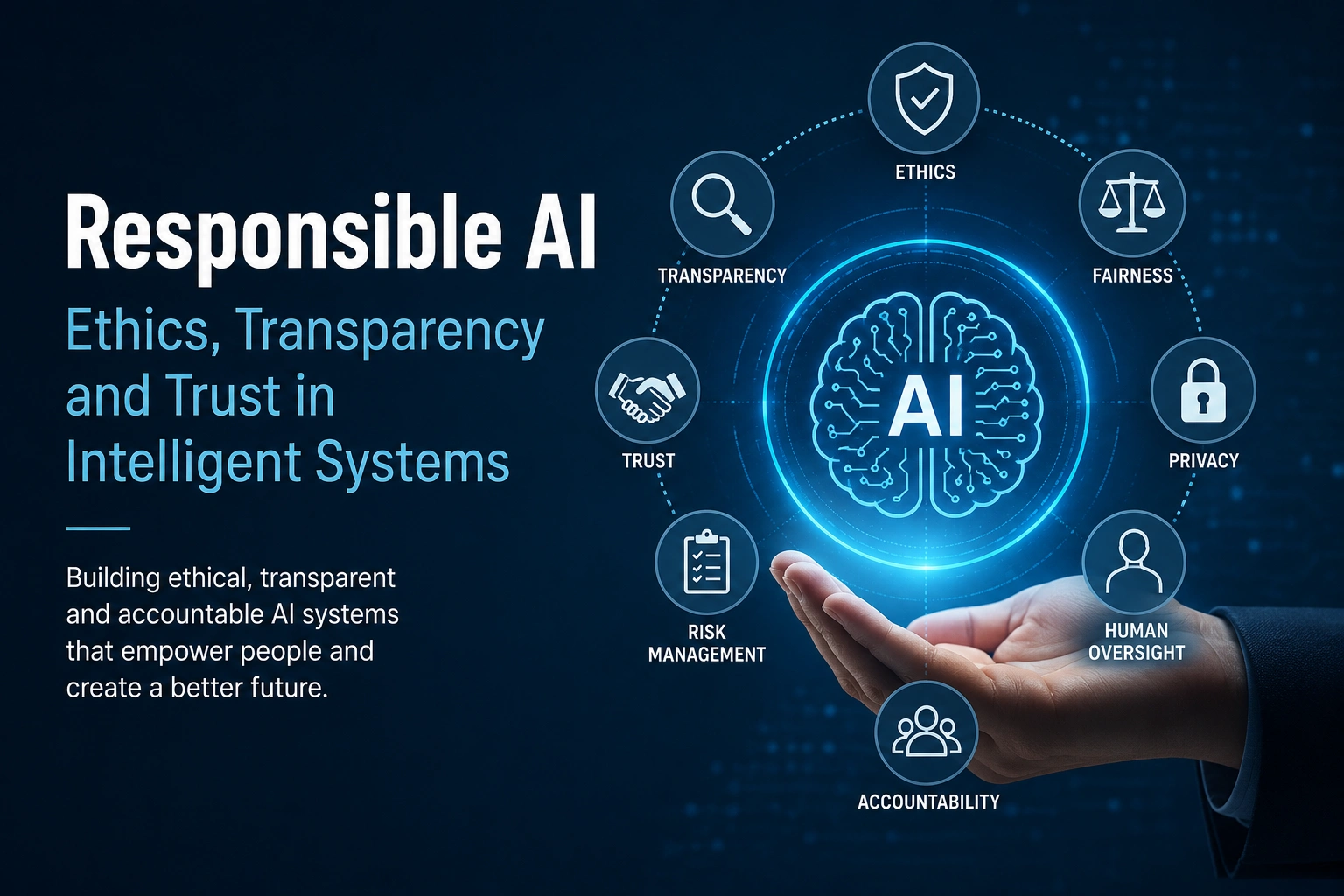
Artificial intelligence is becoming part of everyday decision-making, from customer support and healthcare to finance, manufacturing, education, and public services. As intelligent systems influence more aspects of society, technical performance alone is no longer enough. Organizations are increasingly expected to demonstrate that AI systems are reliable, understandable, fair, and aligned with human values throughout their lifecycle.
Responsible AI represents that broader commitment. It combines engineering discipline, ethical thinking, governance, and continuous oversight to ensure that intelligent systems create lasting value while minimizing unintended consequences. Rather than slowing innovation, responsible practices make AI more dependable, sustainable, and worthy of public confidence.
Building trustworthy AI requires more than publishing ethical principles. It depends on how systems are designed, how data is managed, how decisions are explained, how risks are monitored, and how accountability is maintained long after deployment.
Why Responsible AI Has Become a Strategic Priority
Organizations increasingly rely on Artificial Intelligence to automate complex tasks, generate insights, and support human decision-making. As these capabilities expand, so does the responsibility to ensure that automated outcomes remain accurate, explainable, and socially beneficial.
Poorly governed AI can create risks that extend beyond technical failures. Biased recommendations, opaque decision processes, privacy concerns, security vulnerabilities, and misuse of generated content can undermine confidence among customers, employees, regulators, and business partners.
Responsible AI addresses these challenges by integrating ethical and operational safeguards directly into the development process instead of treating them as afterthoughts.
The objective is not perfect automation. The objective is dependable automation that remains accountable to the people it affects.
Designing Intelligence Around Human Values
Technology should adapt to people rather than forcing people to adapt to technology. Human-centered AI development emphasizes understanding the context in which intelligent systems operate and designing experiences that support human judgment instead of replacing it.
This approach encourages developers to consider practical questions throughout the design process:
- Who is affected by automated decisions?
- Could certain groups experience unintended disadvantages?
- Can users understand why an outcome occurred?
- Is there an appropriate mechanism to question or correct decisions?
- Does automation genuinely improve outcomes compared with human-only processes?
Embedding these considerations early produces systems that are both technically capable and socially responsible.
Transparency That Builds Confidence
Transparency is often misunderstood as revealing source code or proprietary algorithms. In practice, meaningful transparency focuses on helping people understand how AI systems are used, what information they rely on, and where their limitations exist.
Clear communication strengthens confidence by explaining:
- the intended purpose of the system
- the types of data involved
- situations where AI recommendations should receive additional review
- known limitations and uncertainty
- the role humans continue to play in decision-making
Transparency allows organizations to set realistic expectations instead of encouraging misplaced trust in automation.
Explainability Without Technical Complexity
Not every AI model can provide simple explanations for every prediction. However, organizations can still make AI decisions understandable enough for users, customers, and stakeholders to evaluate outcomes with confidence.
Practical explainability includes:
- describing the primary factors influencing recommendations
- documenting decision criteria where possible
- distinguishing predictions from verified facts
- highlighting uncertainty instead of presenting every output as absolute truth
- providing mechanisms for review and correction
The appropriate level of explanation depends on the context. Decisions affecting healthcare, finance, employment, or public services generally require higher levels of interpretability than low-risk applications.
Fairness Requires Continuous Evaluation
Fairness is not achieved through a single technical adjustment. It requires ongoing assessment across the entire AI lifecycle because bias can emerge from multiple sources.
Potential contributors include:
Historical Data
Training data often reflects historical inequalities, incomplete records, or unequal representation that models may unintentionally learn.
Feature Selection
Variables that appear neutral may indirectly represent sensitive characteristics, creating unintended disparities across demographic groups.
Deployment Context
A model performing well in one environment may generate different outcomes when applied to another population or business process.
Responsible AI therefore treats fairness as a continuous quality objective rather than a one-time validation exercise.
Bias Mitigation Is an Engineering Practice
Bias cannot always be eliminated entirely, but it can be identified, measured, monitored, and reduced through disciplined engineering practices.
Effective mitigation commonly includes:
- improving data quality
- increasing dataset diversity
- validating outputs across multiple user groups
- performing independent evaluations
- monitoring real-world performance after deployment
- updating models when new evidence reveals unintended outcomes
Organizations that routinely evaluate bias improve both technical reliability and public trust.
Privacy Should Shape AI From the Beginning
Data Privacy is fundamental to responsible AI because intelligent systems frequently depend on large volumes of information.
Responsible organizations minimize unnecessary data collection, establish clear governance over sensitive information, and protect personal information throughout storage, processing, and model development.
Privacy-aware AI also encourages thoughtful decisions regarding:
- data retention
- user consent
- secure processing
- anonymization where appropriate
- access controls
- responsible sharing of information
Strong privacy practices support long-term trust without limiting innovation.
Accountability Cannot Be Delegated to Algorithms
AI systems may automate decisions, but responsibility always remains with the organizations and people deploying them.
Effective accountability establishes clear ownership for:
- system design
- model validation
- deployment approval
- operational monitoring
- incident response
- ongoing improvement
Assigning defined responsibilities ensures that important decisions remain subject to human governance rather than algorithmic autonomy.
Human Oversight Makes Automation More Reliable
Responsible AI recognizes that automation performs best when combined with informed human judgment.
Human oversight is particularly valuable when:
- decisions involve significant personal impact
- unusual circumstances arise
- confidence scores indicate uncertainty
- conflicting information appears
- ethical considerations extend beyond measurable data
Rather than reducing efficiency, well-designed oversight improves resilience and helps organizations respond appropriately when unexpected situations occur.
AI Governance Connects Principles With Daily Operations
Ethical principles have limited value unless they influence everyday development and operational practices.
AI Governance provides the organizational structure that translates high-level commitments into measurable processes.
A mature governance framework typically includes:
Clear Development Standards
Engineering teams follow documented requirements covering data quality, model validation, documentation, testing, deployment, and monitoring.
Defined Risk Reviews
Projects undergo structured assessments before deployment to evaluate technical, ethical, operational, and security considerations.
Continuous Monitoring
Performance is evaluated throughout the operational lifecycle instead of ending once deployment is complete.
Executive Accountability
Leadership maintains visibility into significant AI systems and ensures governance receives adequate resources and organizational support.
Governance transforms responsible AI from an aspiration into an operational discipline.
Managing AI Risk Throughout the Lifecycle
Risk Management begins long before a model reaches production and continues until the system is retired.
Responsible organizations evaluate risks associated with:
- inaccurate outputs
- unintended bias
- cybersecurity threats
- data quality
- model drift
- misuse by malicious actors
- changing business environments
- evolving societal expectations
Continuous monitoring allows organizations to identify emerging issues before they become larger operational or reputational problems.
Responsible Innovation Encourages Sustainable Progress
Innovation and responsibility are often presented as competing priorities, yet sustainable innovation depends on public confidence.
Organizations that consistently demonstrate ethical development practices are more likely to earn stakeholder trust, strengthen customer relationships, and reduce operational uncertainty.
Responsible innovation therefore becomes a competitive advantage by enabling organizations to introduce advanced capabilities without sacrificing credibility.
Digital Trust Is Earned Through Consistency
Trust cannot be established through marketing claims alone.
Users evaluate AI systems based on consistent experiences:
- reliable performance
- understandable decisions
- respectful data handling
- effective security
- transparent communication
- willingness to correct mistakes
Every interaction contributes to an organization’s reputation for Digital Trust.
Responsible AI supports that reputation by ensuring technical excellence is matched with ethical responsibility.
The Expanding Role of Responsible AI in Generative Systems
Large Language Models and other generative AI technologies introduce new opportunities alongside new responsibilities.
Unlike traditional predictive models, generative systems can create text, software, images, summaries, and recommendations that appear highly convincing. This increases the importance of validation, factual accuracy, source awareness, human review, and safeguards against misuse.
Organizations adopting generative AI increasingly focus on:
- content verification
- responsible prompt management
- disclosure of AI-assisted outputs where appropriate
- protection against harmful or misleading generation
- ongoing evaluation of evolving model behavior
These practices help ensure that rapidly advancing AI capabilities remain aligned with organizational values and user expectations.
Building Responsible AI Into Organizational Culture
Responsible AI succeeds when it becomes part of organizational culture rather than a compliance exercise.
This requires collaboration across engineering, product development, cybersecurity, privacy, legal, leadership, and user experience teams.
Organizations that integrate responsibility into planning, design, deployment, and continuous improvement create systems that remain adaptable as technology and societal expectations evolve.
Long-term success depends less on isolated technical controls and more on cultivating a culture where ethical considerations are treated as essential components of quality engineering.
Responsible AI Is the Foundation of Trusted Innovation
Artificial intelligence will continue transforming industries, economies, and everyday life. Its long-term success, however, depends on more than increasingly capable models.
Responsible AI provides the foundation for intelligent systems that remain transparent, accountable, fair, secure, and aligned with human interests. It encourages organizations to view trust as a measurable outcome of disciplined design, thoughtful governance, continuous oversight, and responsible innovation.
As AI capabilities continue to expand, the organizations that combine technical excellence with ethical leadership will be best positioned to earn public confidence, strengthen Digital Trust, and build intelligent systems that deliver lasting value for both business and society.
Frequently Asked Questions
Why is Responsible AI important beyond technical accuracy?
Accurate models can still produce unfair, opaque, or inappropriate outcomes. Responsible AI ensures that intelligent systems are also transparent, accountable, secure, and aligned with human values, making them more dependable in real-world use.
Can Responsible AI slow innovation?
Well-designed governance generally improves innovation by identifying risks early, reducing costly failures, and increasing confidence among users, customers, and stakeholders. Responsible development enables sustainable adoption rather than limiting technological progress.
Who is responsible for AI decisions?
Responsibility always remains with the organizations and individuals that design, deploy, and manage AI systems. Algorithms can assist decision-making, but accountability cannot be transferred to software.
How does Responsible AI relate to AI Governance?
Responsible AI defines the principles that guide ethical development, while AI Governance establishes the policies, oversight, processes, and operational controls that put those principles into practice.
How can organizations strengthen public trust in AI?
Trust grows when organizations communicate openly about how AI is used, protect personal data, evaluate fairness continuously, maintain human oversight, monitor systems after deployment, and respond transparently when problems arise.